Run the OPD without the waiting-room crowd
Live queue tokens on the patient's own phone, one schedule every booking channel writes into, ABHA-linked registration, a single-screen consultation with AI prescription drafting, and the OPD bill assembled from the visit itself.
Last updated:
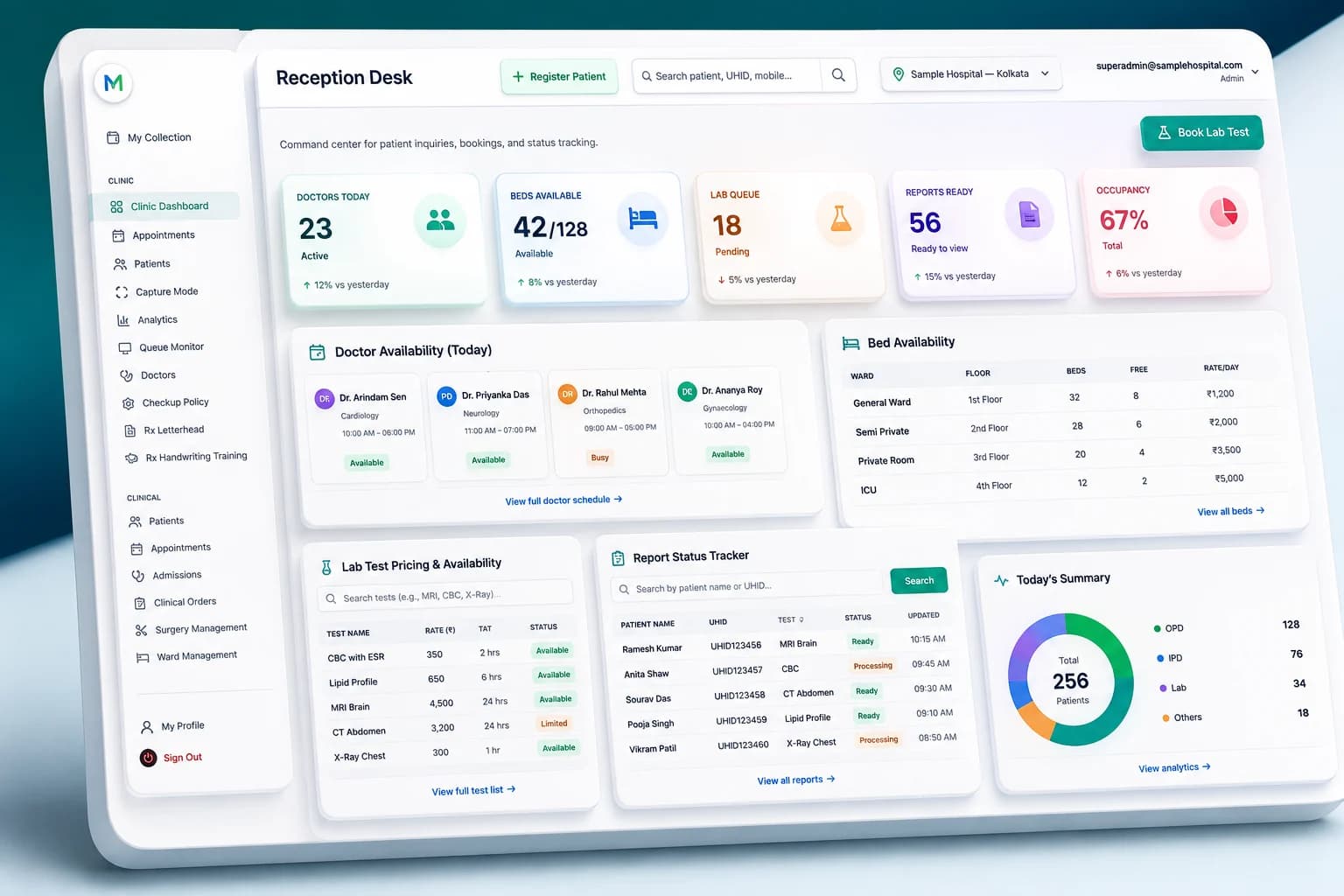
Built for Indian outpatient departments
- ABDM-compliant (M1–M3)
- DPDP Act aligned
- Works offline-tolerant
- Walk-in and appointment queues
- Local-language dictation
- Multi-doctor & multi-site
What is OPD management software?
OPD management software runs a hospital’s outpatient department end to end — patient registration, doctor schedules and appointment slots, the waiting queue, the consultation record, prescriptions, lab and imaging orders, outpatient billing and daily OPD reporting. It differs from appointment-booking software, which handles only the slot, and from an EMR, which handles only the clinical record. Medikunj provides OPD management inside a single hospital operating system, with live WhatsApp QR queue tokens, ABHA creation at registration, a single-screen consultation EMR that drafts the prescription from speech, and OPD billing assembled from the visit record itself.
The problem
Why the OPD is where an Indian hospital's day goes wrong
Nobody loses a patient because a feature was missing. They lose the morning because the queue exists only in the corridor and in one receptionist's head — and everything downstream inherits that.
- 1
The queue is a crowd, and the crowd is unmanaged
Forty people are waiting. Nobody — including reception — can say who is eleventh. So every one of them stands where they can hear their name called, which is why the corridor is full. When a doctor runs late, the information reaches the patients last, and it reaches them as a rumour.
- 2
The same patient is registered three times before lunch
Reception enters them. The pharmacy enters them again to issue medicine. The billing desk enters them a third time. Each re-entry is a chance for the name, the age or the charge to diverge — and reconciling those differences quietly becomes somebody's daily job.
- 3
The front desk is a phone line with a person attached
What are the doctor's timings, is my report ready, can I change my appointment, what will it cost. The same four questions, all day, answered by the same person who is also supposed to be registering the queue standing in front of them.
Already know what you need?
OPD is in the Entry plan at ₹1,999/month — you can be running tokens today.
No implementation project, no consultant to wait for. Book a 20-minute walkthrough of a live OPD session, or keep scrolling for the detail.
Capabilities
What Medikunj does in the OPD
One patient record, from the moment they reach the desk to the moment the bill is settled. These are the seven pieces that decide whether an outpatient morning runs or collapses.
How does the OPD queue actually work for a patient?
Medikunj issues a live queue token to the patient's own phone by WhatsApp QR, so the patient can see their position without standing in the waiting area to hold it.
Reception scans or shares the QR at registration and the token goes to the patient's phone. As the queue moves, the position updates on the phone — so a patient who is eleventh in line can sit outside, take a call, or get a coffee instead of guarding a chair. The reception desk sees the same queue as a list, and doctors pull the next patient from their own console without anybody calling a name over the noise.
Reception stops managing a crowd and starts managing a list.
How are doctor schedules and appointment slots managed?
Medikunj holds each doctor's OPD sessions, slot length and leave in one schedule, and books every channel — walk-in, phone, WhatsApp and online — into that same schedule.
Because there is one schedule rather than a register at reception and a separate diary per doctor, double-booking stops being possible. Sessions can differ by day, consultants who visit twice a week get their own pattern, and a cancelled session releases its slots back rather than stranding patients who were told to come. Reception can export a doctor's daily list for the consulting room.
One schedule, four booking channels, no double-booked slot.

How fast is patient registration, and where does ABHA fit?
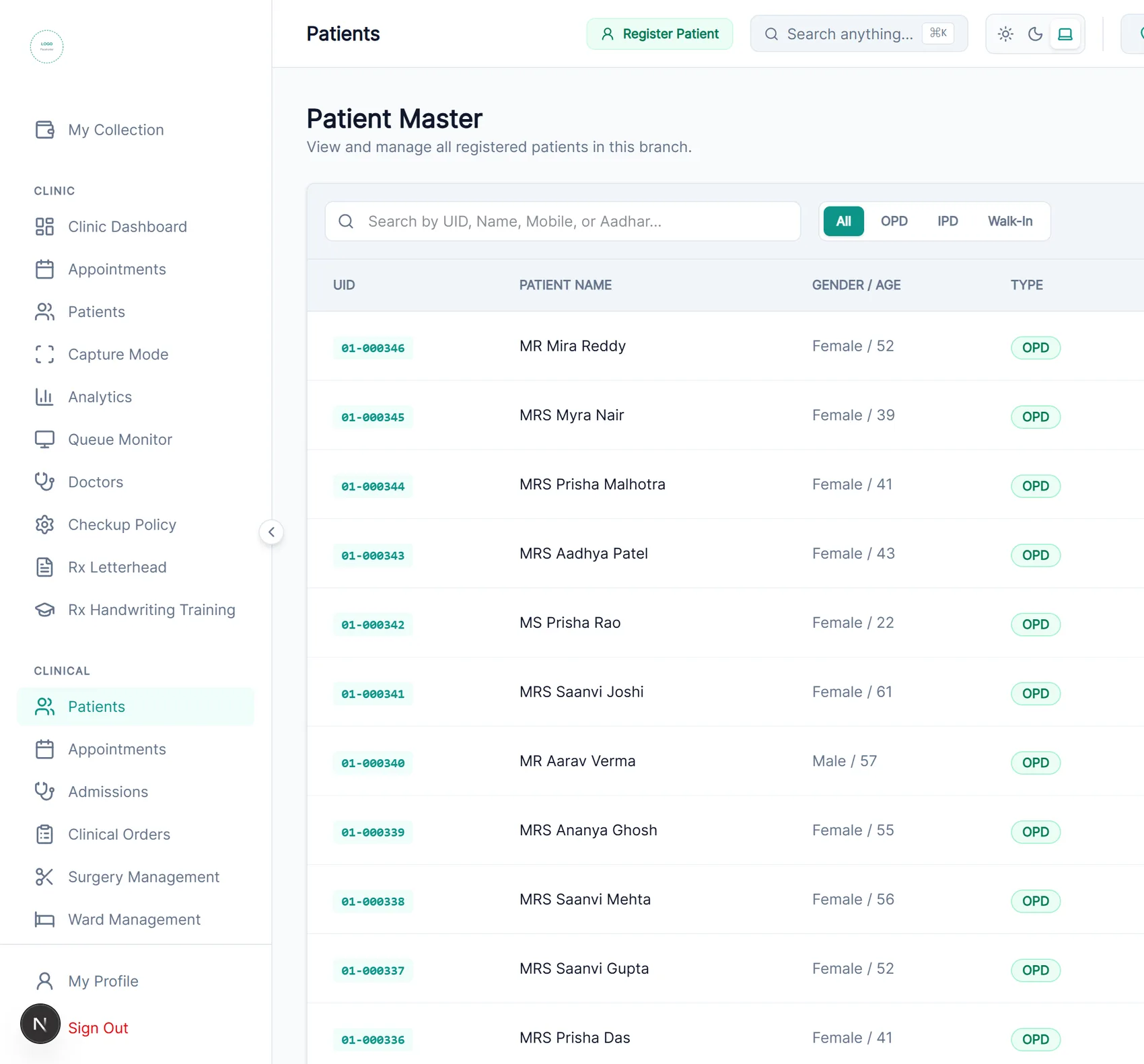
Medikunj registers a patient once into a single patient master, and creates or verifies their ABHA number inside that same registration screen rather than in a separate government portal.
A returning patient is found by UHID, name, mobile or Aadhaar and never re-entered. A new patient is created once, and every later visit, prescription, lab order and bill attaches to that one record. ABHA creation and verification happen in the registration flow, so the front desk is not switching to another site and re-keying a name it has already typed.
The same patient stops existing three times in three systems.
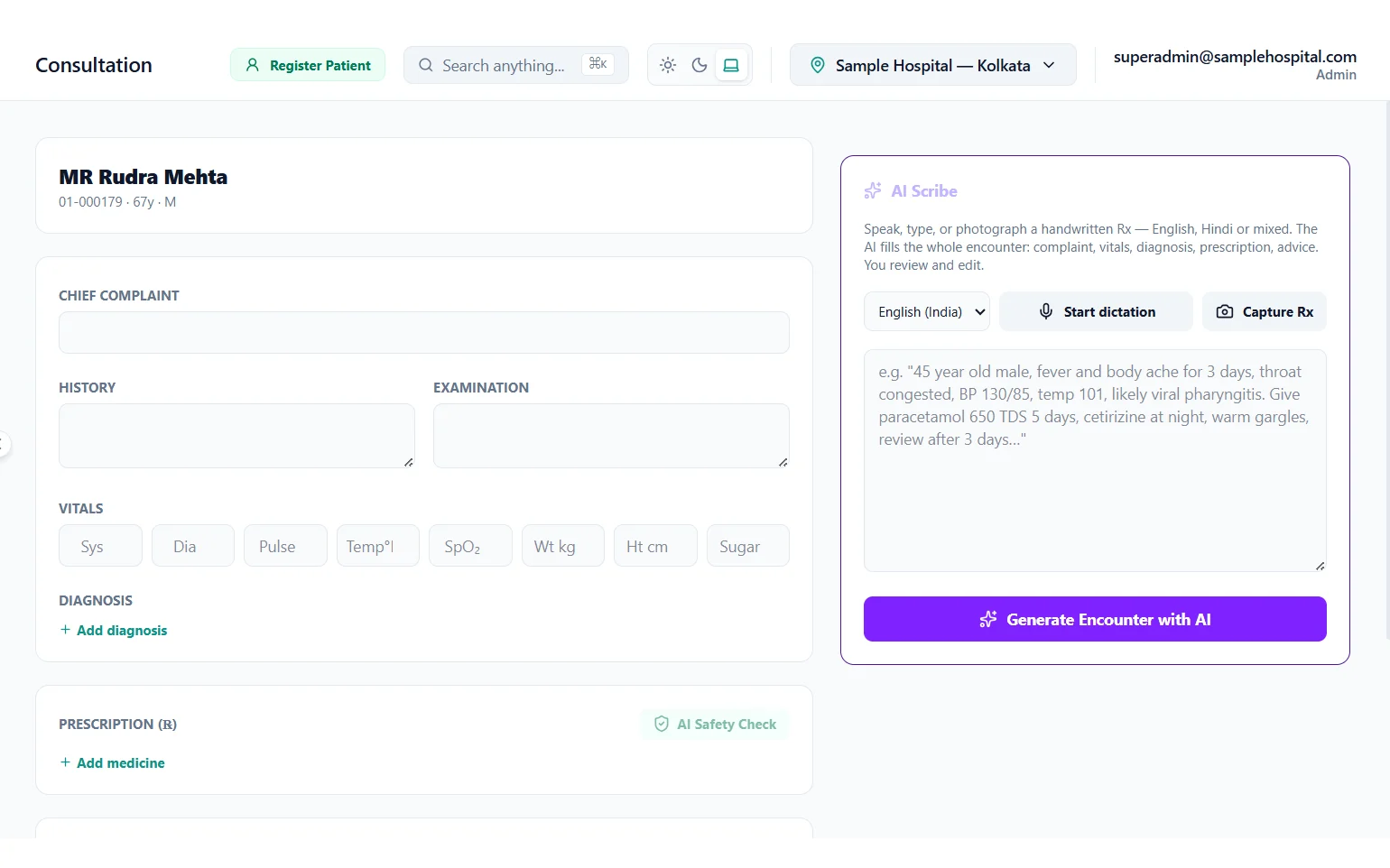
What does the doctor see when the patient walks in?
Medikunj gives the doctor a single consultation screen — complaint, history, examination, vitals, diagnosis and prescription — with AI Scribe able to fill the whole encounter from speech, typed notes or a photographed handwritten prescription.
There is no tab-switching between a notes screen, a prescription screen and a lab-order screen. The doctor can dictate in English, Hindi or a mix, or photograph the Rx they have already written by hand, and the AI fills the structured encounter for review. Lab and imaging orders are raised from the same page and land in the laboratory and radiology queues immediately.
Consultation notes finish inside the consultation, not after clinic hours.
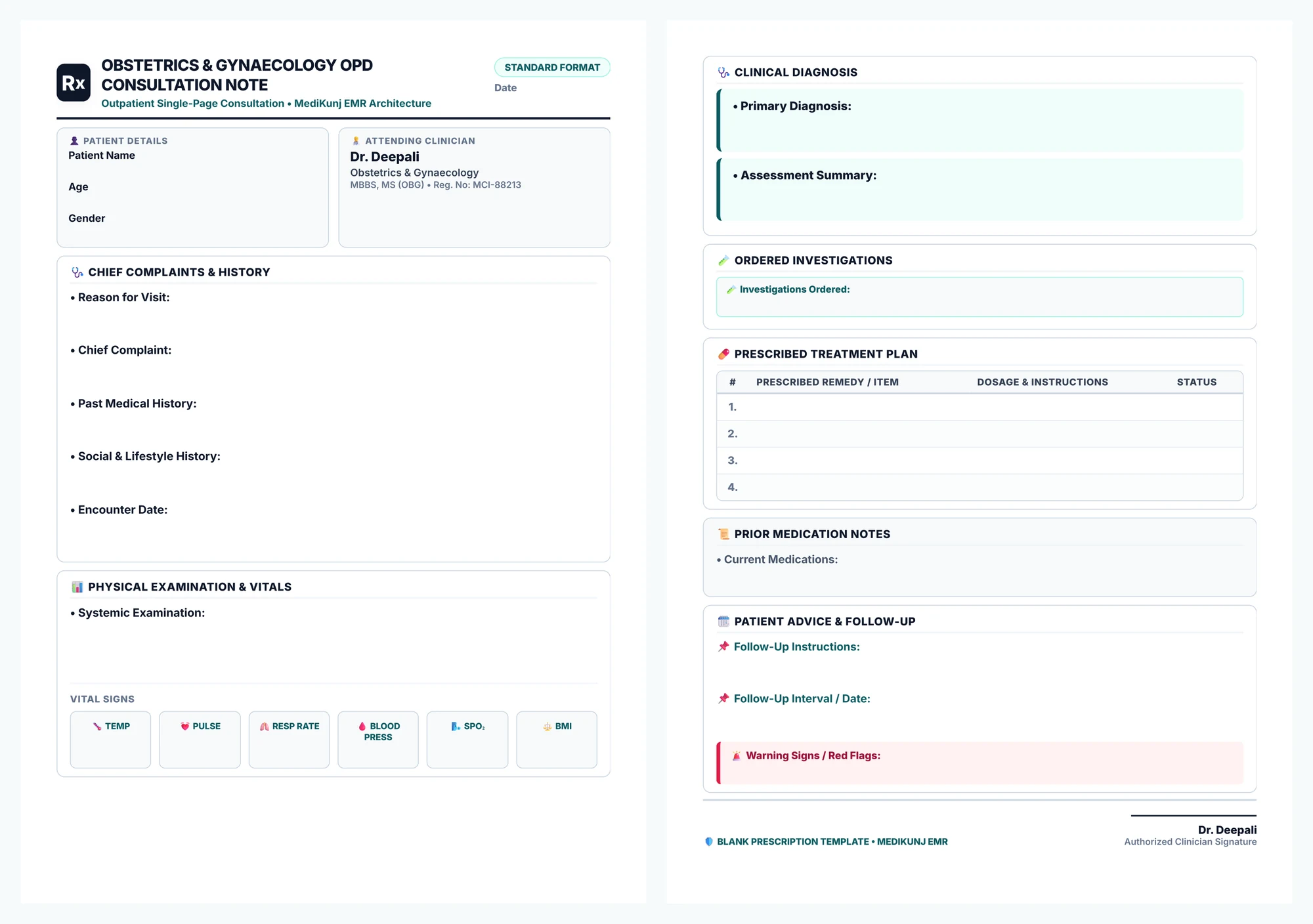
What does the prescription the patient walks out with look like?
Medikunj prints a structured prescription on the hospital's own letterhead — patient details, complaints, vitals, diagnosis, investigations and the treatment plan — instead of a handwritten slip the pharmacy has to interpret.
Because the prescription is structured rather than free text, the pharmacy reads drug, dose, frequency and duration as fields, the follow-up date is recorded rather than remembered, and the whole thing is retrievable at the next visit. Patients can be sent the same prescription on WhatsApp.
The pharmacy stops phoning the doctor to ask what the writing says.
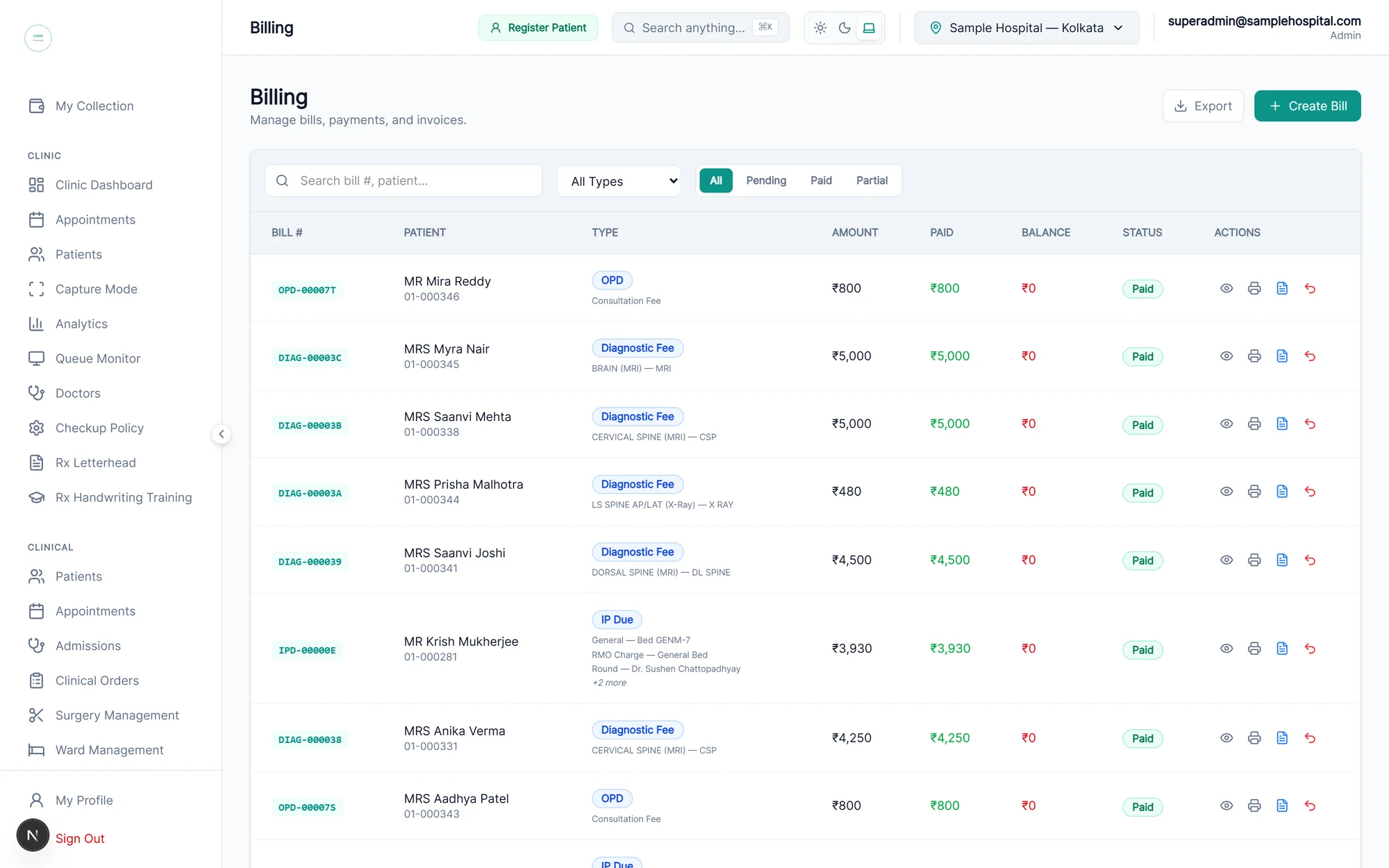
How is OPD billing and collection handled?
Medikunj raises the OPD bill from the same visit record that ran the consultation, so consultation fees, procedures, injections and investigations are billed as they are ordered rather than reconstructed at the counter.
Consultation charges post at registration, and anything the doctor orders during the visit attaches to the same bill. Outstanding amounts — patient, TPA and corporate — appear on collection sheets the billing desk can work down daily instead of discovering at month end.
What the doctor ordered is what the counter collects.
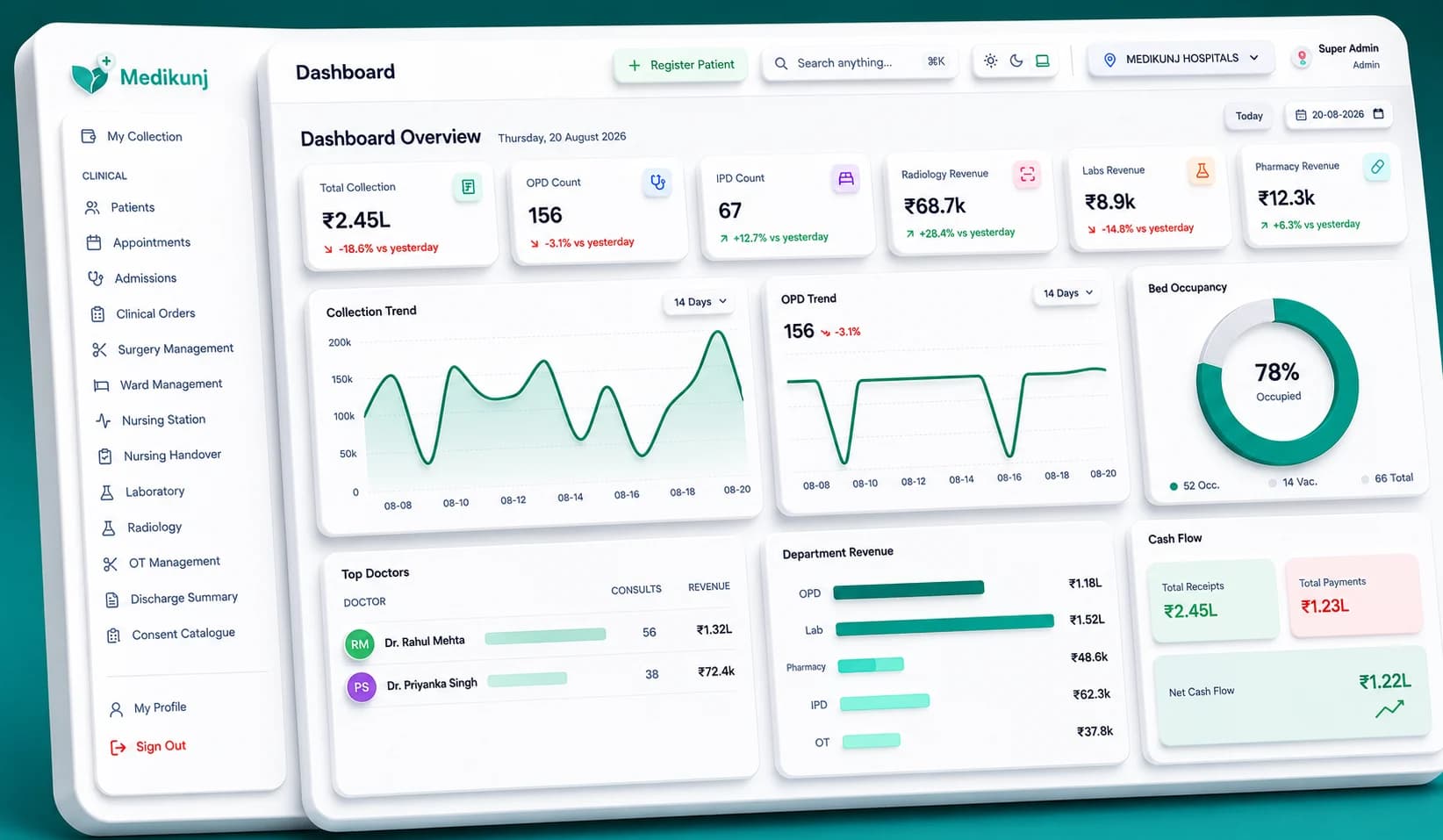
What does OPD data tell management at the end of the day?
Medikunj reports OPD throughput, no-shows, doctor-wise consultation counts, revenue per department and collection trend on the same day, not at month end.
Because registration, consultation and billing write to one system, the outpatient numbers are a by-product of the day rather than a data-entry exercise after it. Multi-site groups can see each unit separately or consolidated.
Yesterday's OPD is on your screen this morning.
The AI layer
The AI layer — and exactly where a human still signs off
In the OPD, AI earns its place by removing phone calls and typing, not by making clinical decisions. Each capability below states what the software does and what a person still confirms — because in an outpatient department that distinction is the whole question.
AI voice calls and WhatsApp automation at the front desk
Appointment confirmations, reminders, rescheduling requests and routine enquiries — where is my report, what are the doctor's timings — are handled by voice and WhatsApp automation rather than a person on a phone all day. This is the capability that most directly changes OPD economics, because the front desk is the cost that scales with patient volume.
Human in the loop: anything clinical, and any conversation the automation cannot confidently resolve, is escalated to a human at the front desk with the conversation context attached. The automation books, confirms and reminds; it does not advise.
AI Scribe — the consultation encounter
The doctor speaks, types, or photographs a handwritten prescription, and Medikunj fills the structured encounter: complaint, vitals, diagnosis, prescription and advice. Dictation works in English, Hindi or a mix, so the doctor is not forced to think in a second language to record a note.
Human in the loop: the doctor reviews and edits every field before the encounter is saved, and signs every prescription before it is issued. Nothing reaches a patient or a pharmacy unsigned.
Live queue prediction and load balancing
The queue reflects how the session is actually running rather than the times printed at booking, so a patient whose doctor is running forty minutes late sees that on their phone instead of discovering it in the corridor.
Human in the loop: reception retains manual override on the queue at all times — a genuine emergency, a frail patient or a doctor's own instruction outranks the queue order, and the software does not argue.
AI-powered outpatient analytics
Daily analytics surface what changed in the OPD — no-shows rising on a particular session, a doctor's throughput dropping, collections slowing — rather than leaving management to find it in a monthly report.
Human in the loop: analytics flag and rank; they do not act. Every scheduling and staffing decision stays with your management team.
If a vendor cannot tell you what their AI does when it is wrong, and who catches it, that is the answer to ask harder about. Automation should reduce administrative load without moving clinical responsibility.
Outcomes
What changes, and how it was measured
A number without its measurement conditions is worth nothing to somebody evaluating clinical software, so each figure below states what was measured and where it does not apply.
~45%
Reduction in OPD waiting-room congestion
Measured at Medikunj pilot sites after introducing live WhatsApp QR queue tokens. Depends on OPD volume and clinic layout — a single-corridor clinic sees less of this than a facility where patients can wait elsewhere.
₹18,000 → ₹1,999
Monthly front-desk cost replaced by voice and WhatsApp automation
Compares one full-time front-desk salary against the Entry plan list price of ₹1,999/month, exclusive of 18% GST. Facilities keep front-desk staff for what automation escalates — the figure is the cost of the calls, not the cost of the person.
Same day
From payment to first OPD appointment booked
Self-serve onboarding for a facility starting without legacy data. Facilities migrating existing patient records go live after migration.
Comparison
Your OPD today, and your OPD on Medikunj
The comparison that decides this purchase is not another vendor's feature grid — it is how your outpatient department runs on a Tuesday morning, and what that is quietly costing you.
| Capability | How the OPD usually runs | With Medikunj |
|---|---|---|
| The queue | Patients crowd the corridor; reception calls names over the noise | Live WhatsApp QR token on the patient's own phone, updating as the queue moves |
| Appointment booking | A register at reception, plus a diary per doctor, plus phone calls nobody logged | One schedule per doctor; walk-in, phone, WhatsApp and online all book into it |
| Doctor running late | Nobody tells the waiting patients, because nobody knows how to | The queue reflects the session as it is actually running, on the patient's phone |
| Registration | The same patient entered again at reception, pharmacy and billing | One patient master; a returning patient is found, not re-created |
| ABHA | A separate government portal, re-keyed by the front desk | ABHA creation and verification inside the registration screen |
| Consultation notes | Handwritten, or typed after clinic hours from memory | Single-screen encounter; AI Scribe drafts from speech, typing or a photographed Rx |
| The prescription | A handwritten slip the pharmacy interprets and nobody can retrieve later | Structured prescription on your letterhead, retrievable at the next visit, sendable on WhatsApp |
| Lab and imaging orders | A chit carried to the counter, entered again by the lab | Raised on the consultation screen, in the lab and radiology queues immediately |
| OPD billing | Reconstructed at the counter from the doctor's notes and the patient's memory | Assembled from the visit record as the orders are placed |
| No-shows | Counted, if at all, when somebody notices the day was quiet | Tracked per session and per doctor, with automated reminders working against them |
| Front-desk enquiries | One person on the phone all day answering the same four questions | Voice and WhatsApp automation answers them; humans take what it escalates |
| Yesterday's OPD numbers | Compiled at month end from registers | On the dashboard this morning |
This table compares Medikunj against the manual and part-digital outpatient workflows common in Indian facilities. For a vendor-by-vendor comparison, see our buyer's guide and our comparison of digital prescription software, which name specific platforms and state when each was assessed.
ABHA & consent
ABHA at registration, and consent for the messages you send
Registration is where ABDM compliance is actually won or lost, because it is the only moment the patient is standing in front of you. Medikunj creates and verifies the patient’s ABHA inside the registration screen rather than in a separate National Health Authority portal, and links the visit, prescription and lab reports to their ABHA address as care contexts. Medikunj is ABDM-compliant, built to the Milestone M1, M2 and M3 integration specifications published by the National Health Authority; Medikunj is not ABDM-certified and does not claim NHA certification.
The second half of this is consent. Queue tokens, confirmations and reminders go out on the basis of consent captured at registration and recorded against the patient record, and under the Digital Personal Data Protection Act, 2023 that consent must be specific and withdrawable. Our ABDM compliance page sets out what each milestone requires, sourced line by line to NHA documentation.
Fit
Is Medikunj right for your OPD?
We could list facility sizes here. Instead, here is the honest version.
Medikunj is for you if
- Your waiting area is fuller than your consulting rooms
- You would like patients to wait somewhere other than your corridor
- Your front desk spends more of the day on the phone than at the desk
- You have more than one doctor and more than one place appointments get written down
- You would like to know today's OPD count today
- You would rather create ABHA at the desk than in a second browser tab
Give Medikunj a miss if
- You believe a queue is best kept in one receptionist's memory
- You would prefer patients discover a doctor is late by standing there
- You enjoy re-typing the same patient at reception, pharmacy and billing
- You think the no-show rate is fine because nobody has ever measured it
- You want your doctors typing notes after clinic hours rather than during
- In general, you would like to make a mistake
Straight answers
The questions OPD vendors usually dodge
These six decide most outpatient software purchases in India. They are worth asking every vendor you shortlist — including us.
Half our patients do not use WhatsApp. Does the queue still work?
Our OPD is mostly walk-in, not appointments. Is this still for us?
Our reception staff are not technical. How long until they are fluent?
What happens to the OPD when our internet drops mid-session?
Are we allowed to message patients on WhatsApp about their appointment?
What does OPD management cost, and is it sold separately?
Free · 60 seconds · no email, no download
What is your OPD really costing you?
Every outpatient department loses money it never sees on a ledger — the slot nobody turned up for, the hours your front desk spends on the phone, the patient who waited fifty minutes and wrote about it on Google. Move the six sliders below to match your facility. You will get a rupee figure, an hours figure, and the honest answer to the only question that matters: how long software takes to pay for itself.
in your OPD on a normal day
booked plus walk-in
count the half-days too
what one patient pays you
your best guess is fine
arrival to consultation
Empty chairs, every month
₹3,36,960
That is 674 consultations a month booked and never attended, at your own fee. Not a projection — it is your no-show rate multiplied by your price.
What Medikunj gets back for you
₹1,01,088
back in the till, monthly
Automated reminders and rebooking recover about 202 of those slots.
123 hrs
off your front desk, monthly
Confirmations, reminders and 'is my report ready' handled by voice and WhatsApp instead of a person.
< 1 day
to pay for itself
Recovered revenue against the ₹1,999/month Entry plan, ex-GST.
And the number nobody puts on a ledger: at a 38-minute average wait, roughly 3,070 patients a month leave your OPD having waited longer than half an hour. Waiting is the single most common subject of a one-star review, and a review outlives the morning that caused it. Live queue tokens cut about 875 hours of that waiting out of your month.
Your receptionist
Stops being a phone line with a person attached, and goes back to looking after the patient standing in front of them.
Your doctors
Finish the notes inside the consultation instead of after clinic hours, because the encounter is dictated, not typed.
Your billing desk
Collects what the doctor ordered, because the bill is assembled from the visit rather than reconstructed at the counter.
You
Know today's OPD count, today — instead of finding out what August was like some time in September.
Every number behind this, in full
Your inputs give 3,744 appointments a month, of which 674 are no-shows and 3,070 are attended. Lost revenue is simply no-shows × your fee.
Recovered slots apply a 30% recovery rate to your no-shows. That is a conservative planning assumption about automated reminders and rebooking, not a Medikunj measurement — treat it as a scenario and substitute your own rate if you have one. For context, published outpatient no-show rates cluster between 23% and 33% globally, so a facility that has never measured its own is usually guessing low.
Front-desk hours assume 4 minutes per attended patient spent on calls, confirmations and repeat registration, of which 60% is absorbed by voice and WhatsApp automation. Both figures are assumptions; time them at your own desk for an hour and you will have better ones.
Waiting hours removed apply the 45% waiting-room congestion reduction measured across Medikunj pilot sites after live WhatsApp QR queue tokens were introduced. It varies with OPD volume and clinic layout: a facility where patients can wait elsewhere sees more of it than a single-corridor clinic.
Payback divides the ₹1,999/month Entry plan list price, exclusive of 18% GST, by the recovered revenue. It counts only recovered consultations — not the front-desk hours, not the consumables that get billed because they were recorded, and not the patient who came back because they were not kept waiting.
This is vendor-neutral arithmetic. Nothing in it depends on buying Medikunj — use it to size the problem before you shortlist anybody, including us.
FAQ
OPD management software: common questions
OPD management software runs a hospital's outpatient department end to end: patient registration, doctor schedules and appointment slots, the waiting queue, the consultation record, prescriptions, lab and imaging orders, OPD billing and outpatient reporting. It is distinct from an appointment-booking tool, which handles only the slot, and from an EMR, which handles only the clinical record. Medikunj provides OPD management as part of a single hospital operating system, so the registration, the queue token, the consultation, the prescription and the bill are all the same patient visit rather than four systems describing it separately.
At registration the patient receives a queue token on their own phone through WhatsApp, reached by scanning a QR code at the desk or by a message to their registered number. The token shows their position in the doctor's queue and updates as the queue moves, so the patient does not have to stand in the waiting area to know when they are next. Reception and the doctor see the same queue. Patients without a smartphone remain in the same queue and are called conventionally.
Appointment booking software allocates a slot. OPD management software runs everything that happens around that slot: registering the patient into a permanent record, sequencing the actual queue on the day, capturing the consultation, issuing the prescription, raising lab and imaging orders, billing the visit and reporting outpatient throughput. A clinic that buys booking software alone still runs the queue on paper and the billing in a second system.
Yes. Walk-in patients are registered and issued a live queue token in the same action, and walk-in tokens and booked appointments share one queue rather than running as two separate lists. This matters because most Indian OPDs are majority walk-in, and a queue system that only sequences pre-booked patients leaves the actual crowd unmanaged.
Yes. Each doctor has their own OPD sessions, slot length, days and leave, including consultants who visit on fixed days only. Because every booking channel writes into the same schedule, double-booking is not possible, and a cancelled session releases its slots rather than stranding patients who were already told to attend. Multi-doctor scheduling is included from the Growth tier upward.
Yes. ABHA number creation and ABHA address verification happen inside the Medikunj registration screen rather than in a separate National Health Authority portal, so the front desk does not re-key a name it has already typed. Medikunj is ABDM-compliant, built to the Milestone M1, M2 and M3 integration specifications published by the National Health Authority. Medikunj is not ABDM-certified and does not claim NHA certification.
Medikunj measured roughly a 45% reduction in waiting-room congestion at pilot sites after introducing live queue tokens. The honest caveat is that software does not make a consultation faster — it removes the time patients spend waiting without information, and it lets them wait somewhere other than your corridor. A facility where patients cannot leave the building sees less benefit than one where they can. Use the free calculator on this page to size it against your own numbers.
Automated confirmations and reminders over WhatsApp and voice reduce no-shows caused by forgetting, which is the largest recoverable category, and rebooking a cancelled slot recovers the session capacity. They do not affect no-shows caused by cost, distance or the patient recovering. Medikunj tracks the no-show rate per doctor and per session so you can see which sessions are actually leaking capacity rather than guessing.
Registration and the OPD queue continue locally during a connectivity loss and sync when the connection returns. These are the two workflows that cannot stop in an outpatient department, which is why they are the ones built to tolerate an outage.
OPD is not sold separately. Reception, appointments, the live queue, the consultation EMR, prescriptions with AI Scribe and OPD billing are included in the Entry tier at ₹1,999/month for a solo doctor or single-location OPD clinic. Growth at ₹5,999/month adds multi-doctor scheduling, pharmacy, laboratory and revenue analytics; Professional at ₹14,999/month adds IPD, wards and insurance for nursing homes and hospitals. Annual billing saves 20% and all prices exclude 18% GST.
Keep reading
Where to go next
Everything below is on medikunj.com, written by the team that builds the software.
See a live OPD session running on Medikunj
A 20-minute working screen-share — registration with ABHA, a live queue token landing on a phone, the consultation and AI-drafted prescription, and the bill assembled from the visit. No slide deck, no obligation.